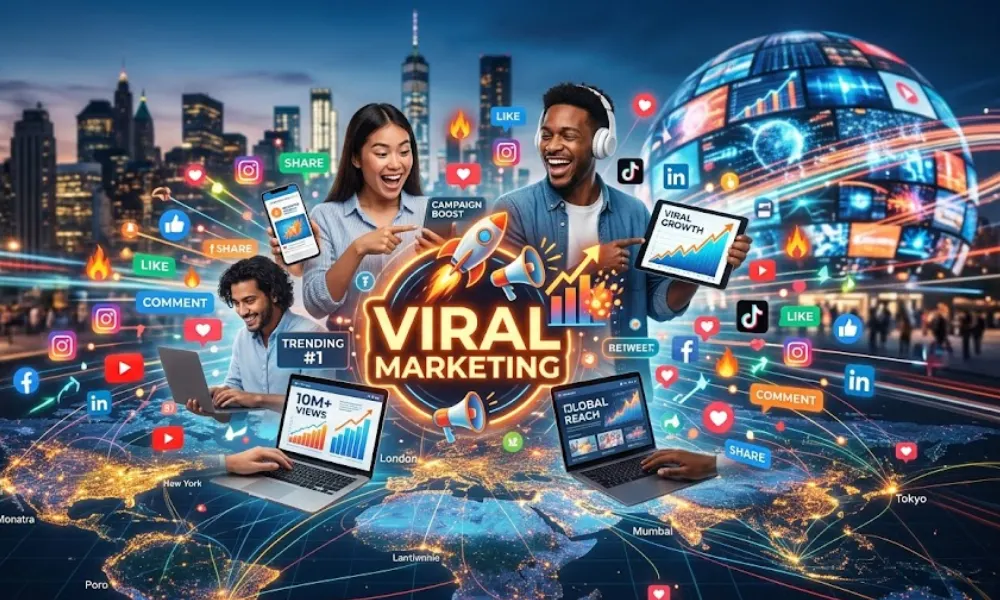
In the digital age, “going viral” is the holy grail of brand awareness. We’ve all seen it happen: a low-budget video from a startup, a witty response from a fast-food chain’s Twitter account, or a participatory challenge that takes over Instagram overnight. Suddenly, everyone is talking about a brand that was virtually unknown 24 hours prior.
But is viral marketing just a stroke of luck, or is there a method to the madness? As it turns out, while you can’t guarantee a piece of content will explode, you can certainly stack the deck in your favor.
At its core, viral marketing is a business strategy that uses existing social networks to promote a product or service. Its name refers to how consumers spread information about a product with other people, much in the same way that a virus spreads from one person to another.
Unlike traditional advertising, where the brand pays to push a message out to an audience, viral marketing relies on the audience to do the heavy lifting. When it works, it provides massive reach at a fraction of the cost of traditional media.
While every viral hit is unique, most share a few common ingredients:
Content that leaves people feeling “meh” stays on the shelf. To go viral, content must evoke strong emotions. This doesn’t always mean happiness; it could be awe, amusement, surprise, or even righteous indignation. According to research, high-arousal emotions (things that get your heart rate up) are far more likely to drive a “share” than low-arousal emotions like sadness or contentment.
People share things that make them look good. This is known as “social currency.” If you share a life-saving “hack” or a deeply insightful industry report, it makes you look helpful or smart to your peers. If you share a hilarious meme, it makes you look funny. If your content provides value or helps the sharer curate their own online persona, they are much more likely to hit send.
If you want something to spread, you have to remove the friction. Viral marketing thrives on platforms where sharing is a one-click process. This is why short-form video (TikTok, Reels) and Twitter are the primary breeding grounds for viral trends.
A common misconception is that viral marketing is entirely organic. In reality, many “viral” hits are carefully seeded. Brands often partner with influencers to give the content its initial push. Once the content reaches a critical mass within a specific niche, the “network effect” takes over, and the general public begins to share it organically.
Before you set out to create the next “Ice Bucket Challenge,” a word of caution: virality is a double-edged sword. Because you relinquish control of the message to the public, the narrative can shift quickly.
If a campaign is misinterpreted or feels forced (often called “cringe”), the backlash can be just as viral as the intended message. Authenticity is the ultimate currency. Modern audiences have a high-tuned “BS meter,” and they can smell a desperate marketing ploy from a mile away.
While the allure of millions of views is strong, viral marketing shouldn’t be your entire strategy. It is unpredictable and difficult to replicate.
Instead, focus on creating high-quality, relatable content that serves your target audience. Use the principles of viral marketing—emotional resonance, utility, and ease of sharing—to improve your everyday engagement. If you consistently put out great work that speaks to people, eventually, lightning might just strike.